Overwhelmed Parenting Reset: Calm in 10 Minutes

When Parenting Feels Like Too Much: A Practical Reset Plan for Overwhelmed Days
Overwhelm in parenting can show up as irritability, numbness, tears, or the sense that everything is urgent. A calmer day doesn’t require perfect routines—it often starts with a few stabilizing steps that reduce pressure, create breathing room, and help a parent respond instead of react. This reset plan is designed for real life: the loud moments, the messy rooms, the “I can’t do one more thing” afternoons—and the next day, too.
Recognize the early warning signs of overload
Overwhelm usually builds before it explodes. Catching it early can prevent the kind of snapping or shutdown that feels awful afterward.
Common signals to watch for
- Body signals: tight chest, clenched jaw, headaches, insomnia, appetite changes.
- Mind signals: racing thoughts, catastrophic “this will never end” loops, decision fatigue.
- Behavior signals: snapping, shutting down, scrolling to escape, yelling faster than usual.
- Parenting triggers: nonstop noise, sibling conflict, transitions, messy rooms, bedtime battles.
A helpful reframe: overwhelm is information—your system is asking for support, not more self-criticism. If you want a quick refresher on how stress shows up physically, the American Psychological Association’s overview of stress effects on the body is a solid reference.
The 10-minute reset for the moment it feels too much
This is a short sequence to run when your patience is gone and your brain feels jammed. The goal isn’t to “calm down perfectly”—it’s to stabilize enough to take the next right step.
- Pause and make it safe: ensure your child is secure (crib, high chair, childproof room) before you step back for a minute.
- Name the state out loud: “This is overwhelm. I’m safe. My child is safe.” Labeling can reduce intensity.
- Regulate your body first: slow exhales (longer out than in) for 60–90 seconds.
- Reduce input: dim lights, lower volume, turn off background TV, move to a quieter room if possible.
- Choose the smallest next step: water, snack, diaper, or a calm activity—one task only.
- Use a bridging phrase: “We’re having a hard moment. We can do the next thing slowly.”
If the moment is chaotic, it can help to anchor your child with one predictable object: a water cup, a simple book, or a comfort item. For some families, having a dedicated “go-to” cup reduces the back-and-forth that adds friction—something like the Silicone Baby Training Cup with Handles – Leakproof & Anti-Spill 6 oz Sippy Cup can be an easy default to keep within reach.
When your child is melting down while you’re overwhelmed
When both of you are escalated, fewer words and more structure usually works better than explanations.
- Keep words short: too many sentences can raise agitation for both of you.
- Hold a boundary with empathy: “I won’t let you hit. You’re mad. I’m here.”
- Offer two simple choices: “Do you want to stomp feet or squeeze a pillow?”
- Create a “calm corner” kit: soft item, sensory toy, water bottle, picture book, headphones.
- If you’re nearing a breaking point: step back for 30–60 seconds after ensuring safety; reset your breathing; return with one sentence and one action.
- After the storm: reconnect with a brief repair—“That was hard. I’m proud we got through it.”
A soft comfort object can be part of the calm corner, especially for younger kids who regulate through touch. If you want a dedicated “calm buddy,” consider something like the Fluffy Fox Plush Toy – Soft Stuffed Animal for Kids & Decor for squeezing, holding, or keeping in a quiet spot.
Lower the daily pressure with fewer decisions
Overwhelmed days get worse when everything requires a decision. Reducing choices isn’t rigid—it’s relief.
Quick reset menu for overwhelmed parenting moments
| Time available | What to do | What it helps |
|---|---|---|
| 60 seconds | Put child somewhere safe, take 6 slow exhales, drink water | Interrupts the stress spiral and lowers physical tension |
| 3 minutes | Reduce noise/light, choose one next task, set a timer | Creates structure when the brain feels scattered |
| 10 minutes | Snack + simple activity (books, blocks), sit on the floor nearby | Co-regulation and a calmer reset without a big plan |
| 20 minutes | Short walk or fresh air + one connection question | Movement helps mood; connection reduces conflict |
Build a support system that actually gets used
For evidence-based parenting tools and practical guidance by age, the CDC’s Essentials for Parenting is a helpful starting point. If anxiety is part of what keeps pushing you into overload, the National Institute of Mental Health overview of anxiety disorders can clarify symptoms and treatment options.
A gentle framework for the day after a hard day
A structured digital guide for overwhelmed parenting days
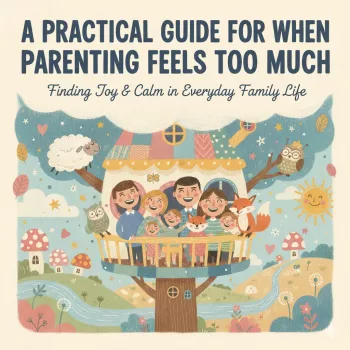
If you want something you can open quickly during a rough moment, A Practical Guide for When Parenting Feels Too Much (digital guide) is designed to be straightforward and easy to reuse.
FAQ
What should a parent do when they feel overwhelmed and about to snap?
Prioritize safety first by placing your child in a secure spot, then regulate your body with slow exhales for 60–90 seconds. Reduce sensory input and choose one tiny next step so your brain has something manageable to do.
Is it normal to feel overwhelmed by parenting?
Yes—overwhelm is common, especially with poor sleep, high stress, or limited support. If it’s persistent or affecting daily functioning, professional support and screening for anxiety or depression can be a practical next step.
How can a parent calm down quickly during a toddler tantrum?
Use short sentences, keep a firm but calm boundary, breathe slowly, and offer two simple choices for safe expression. After the tantrum, reconnect with a brief repair and return to a predictable calming routine.










Leave a comment